
PIK did not spread in Q1 2026. By flow, it shrank.
PIK positions held $54.2 billion of fair market value at the end of Q1, or 11.3% of debt FMV. That is down from 11.6% in Q4 2025. PIK interest fell to 7.0% of reported interest income, from 8.6%.
More loans came off PIK than went onto it. 347 positions across 237 borrowers reverted to cash pay, and 110 of them restored the full cash coupon. Elective flips into PIK totaled 187 positions, close to the 178 in Q4.
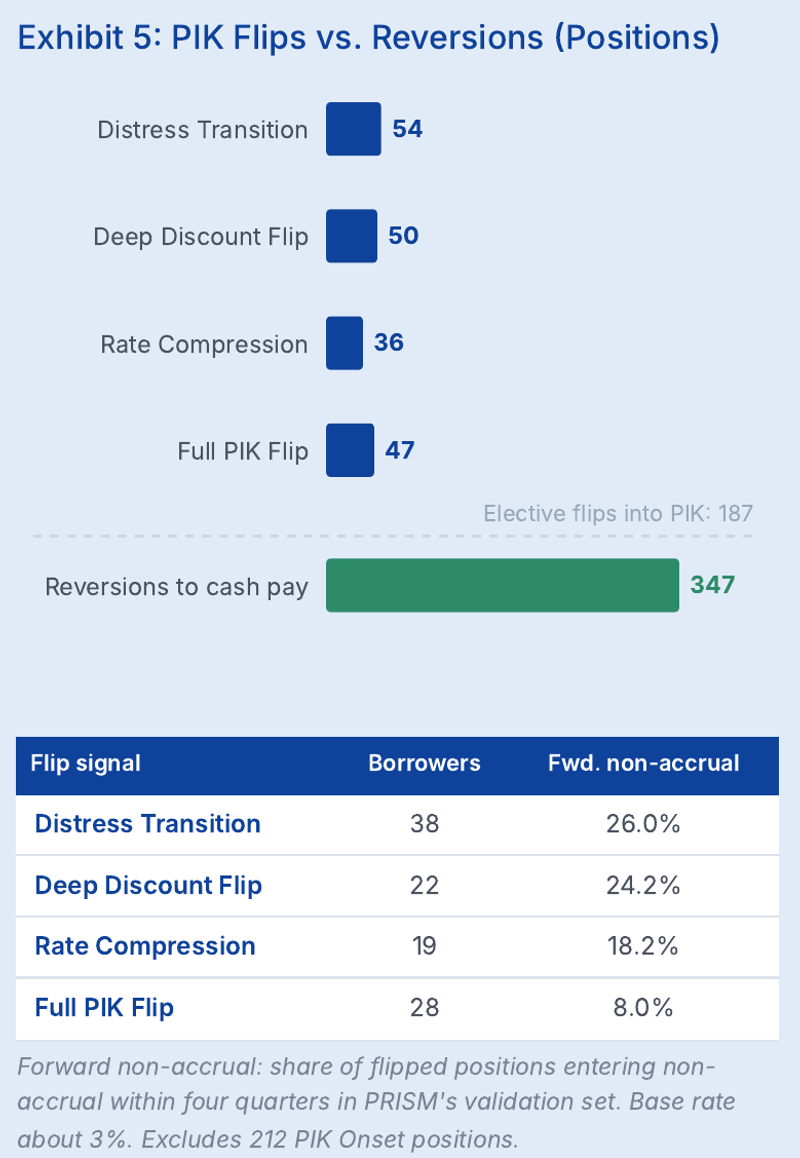
The flips carry the risk signal. PRISM sorts each elective flip into one of four classes. It tracks how often each class enters non accrual within four quarters. The base rate across the market is about 3%.
Distress Transition flips carry a 26.0% forward non accrual rate. Q1 had 54 of them across 38 borrowers. Deep Discount flips carry 24.2%, and Q1 had 50 across 22 borrowers. Rate Compression flips carry 18.2%, with 36 in Q1. Full PIK flips carry 8.0%, with 47 in Q1.
That puts 104 of the 187 flips in the two highest risk classes. Historically, about one in four of those positions enters non accrual within a year. That is roughly eight times the base rate.
A falling PIK share and a cluster of high risk flips can both be true. The reversions show which borrowers are recovering. The high risk flips show which ones are heading the other way.
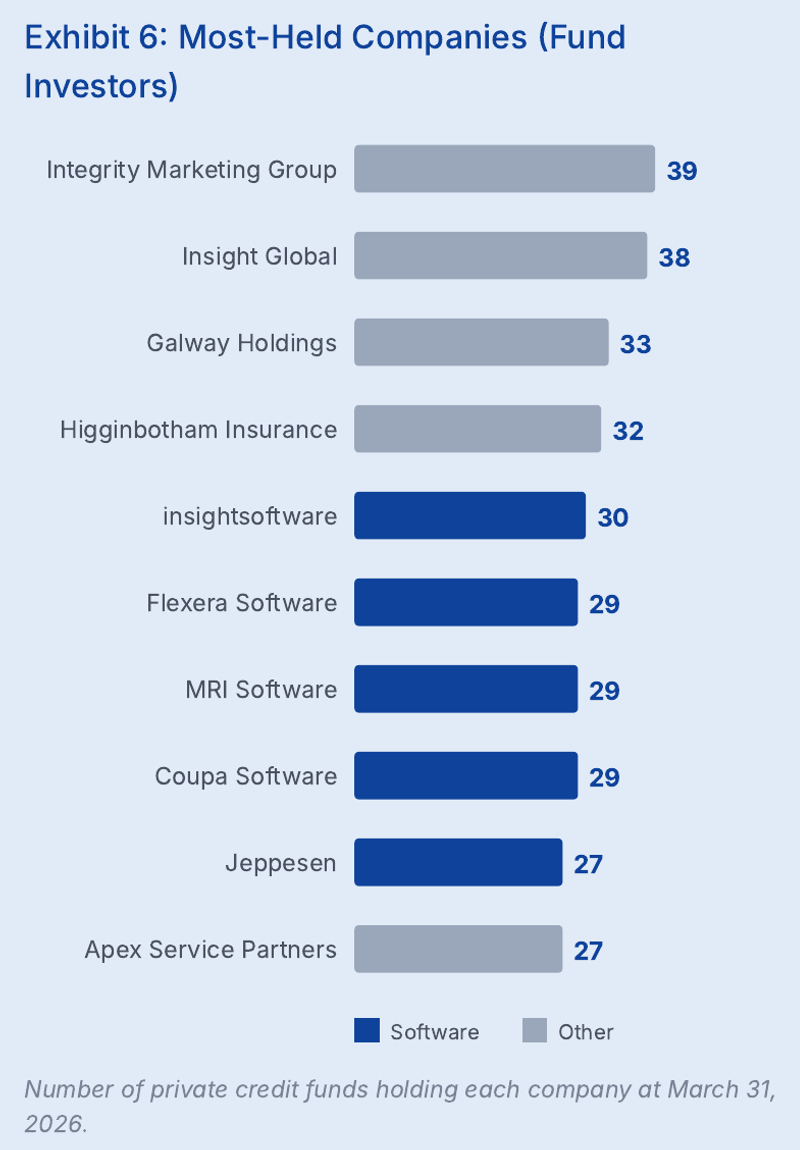
Crowding decides how far a bad flip travels. Integrity Marketing Group sits in 39 portfolios with $1.93 billion of FMV. Insight Global sits in 38. Five of the ten most held names are software companies, including insightsoftware, Flexera, MRI Software and Coupa. A distress flip in one of those names would reach dozens of fund NAVs in the same quarter.
Kaseya showed that path in Q1. It had 27 fund investors at year end. Its lenders cut the mark from 99.8% to 87.2% of cost in one quarter.
If you are an LP, the PIK share in a fund's 10-Q gives you the total and hides the mix. Ask your managers which of their PIK positions flipped this quarter, and which class each flip falls into. A book of Full PIK flips carries far less risk than a book of Distress Transition flips.
The full Q1 2026 Private Credit Quarterly, with all charts and data tables, is available as a downloadable PDF.