
Private credit's same fund book shrank for a second straight quarter in Q2 2026.
PRISM tracks $452.1 billion in debt fair market value across 140 private credit funds and 7,812 portfolio companies as of Q2 2026. The headline fell from $479.3 billion in Q1, mostly because of a filing effect. Cliffwater Corporate Lending files semiannually and is out of the count. At the 135 funds that filed both quarters, debt FMV fell 0.2% to $448.8 billion. It is the second straight decline after nine quarters of 5% to 12% growth.
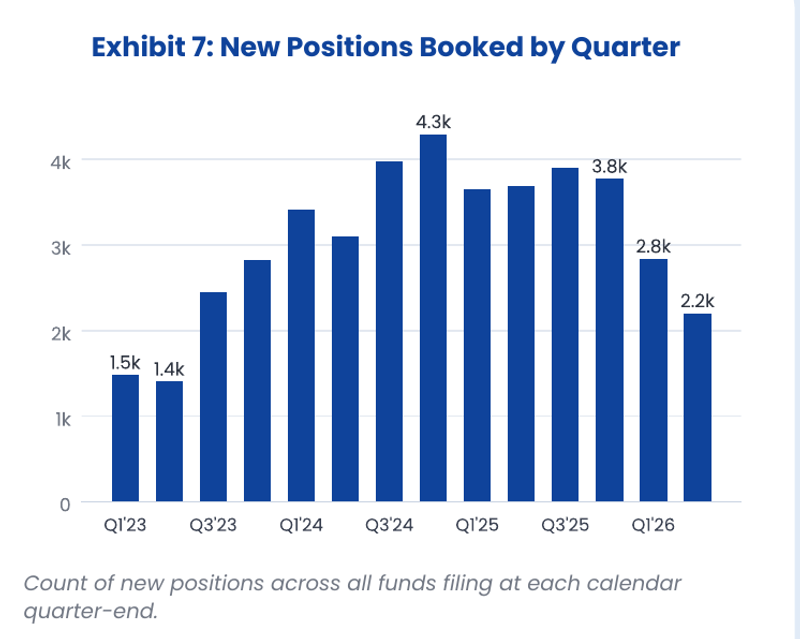
Deployment fell further. Funds booked 2,204 new positions, 42% fewer than the 3,776 in Q4 2025. That is the lowest count since Q2 2023. Entries fell faster than exits. Same fund borrower entries dropped from 2,033 to 1,190, while exits fell from 1,524 to 1,000.
The largest vehicles led the decline. Blackstone Private Credit Fund fell 3.3% to $73.4 billion. HPS Corporate Lending fell 3.6%. Listed funds shrank too. Blackstone Secured Lending fell 4.7% and FS KKR Capital fell 10.5%. Growth now sits with a handful of funds, led by Goldman Sachs Private Credit at 10.5%.
Pricing stayed flat even as deal volume fell. The FMV weighted all in rate was 8.99%, against 9.02% in Q1. The middle half of the market priced between 8.23% and 9.50%. All of the change this quarter came through marks.
Unrealized impairment reached $11.3 billion, up from $9.6 billion in Q1 and $4.6 billion in Q4 2025. It has more than doubled in two quarters. Software holds $4.7 billion of it, or 41%. Six months ago its share was 15%.
The markdown list now reaches past software. Medallia added $196 million of impairment and sits at 50.5% of cost. Dun & Bradstreet, held by 23 funds, slipped to 95.6%. Guidehouse fell to 97.0%. Trucordia, an insurance brokerage, fell to 90.7%. The moves are small, and they come from sectors the market treats as stable.
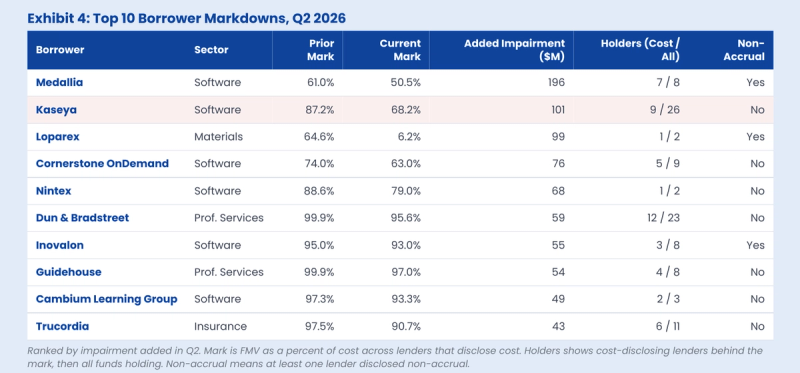
A crowded name broke. Kaseya, held by 26 funds, fell from 87.2% to 68.2% of cost and now sits in the Critical band. A loss on a name this widely held reaches 26 fund NAVs at once.
PIK moved both ways. 131 positions made elective flips into PIK. 252 went back to cash pay, and 154 of those restored the full coupon. Cross lender PIK is broad: 391 borrowers carry it at two or more lenders, and much of that is structured. The sharper signal is 58 borrowers on PIK at three or more lenders with marks below 85% of par. They hold $4.5 billion of PIK FMV.
Flat pricing, rising impairment and fewer deals add up to a market where lenders are getting more selective and doing fewer deals.
If you are an LP in a large perpetual vehicle, the Q3 question is whether net flows turned positive. If BCRED and HPS keep shrinking while impairment rises, the slowdown reflects capital flows as well as deal flow.
The full Q2 2026 Private Credit Quarterly, with all charts and data tables, is available as a downloadable PDF.