
Software was supposed to be the safe trade in private credit. In Q1 2026, it became the largest source of markdowns in a single quarter.
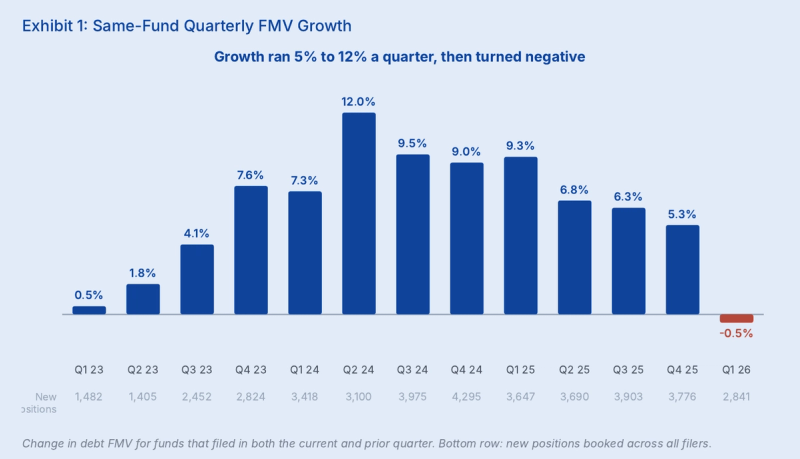
PRISM tracks $479.3 billion in debt fair market value across 141 private credit funds and 7,946 portfolio companies as of Q1 2026. That is $22.7 billion more than Q4 2025, and almost all of the gain came from Cliffwater Corporate Lending. Cliffwater files semiannually and was absent from the prior count. At the 138 funds that filed both quarters, debt FMV fell 0.5%.
That is the first like for like decline in at least three years. Before it, same fund growth ran between 5% and 12% a quarter for nine straight quarters. Deployment slowed with it. Funds booked 2,841 new positions, down 25% from Q4 and the lowest count since Q4 2023.
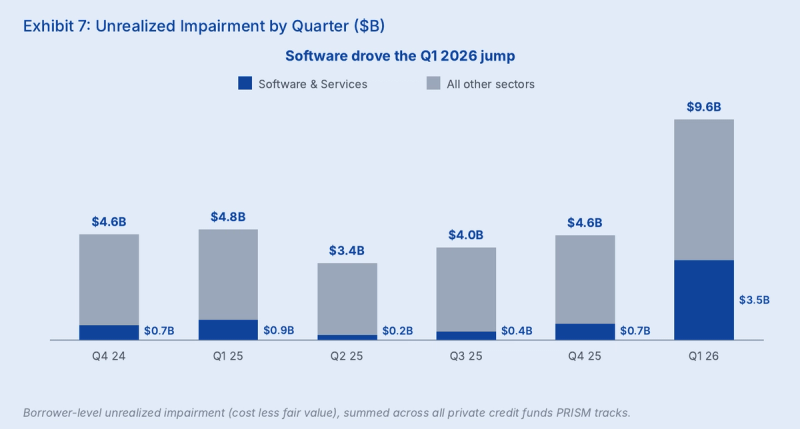
The bigger move was in the marks. Unrealized impairment more than doubled, from $4.6 billion to $9.6 billion. Software alone went from $0.7 billion to $3.5 billion. Its share of total impairment rose from 15% to 36% in one quarter.
The markdowns were broad. Software borrowers marked below 80% of cost rose from 44 to 60. Nine of the ten largest new markdowns were software names. Medallia went from 78% to 61% of cost. Barracuda Networks went from 84% to 54%. All three Blue Owl vehicles cut Barracuda by 30 to 35 points.
The names hit hardest share a profile. Medallia, Cornerstone OnDemand, Qlik, Pluralsight and Tungsten Automation all sell tools a customer can cut or replace in a downturn. In Velcro Score terms, they sit closer to Discretionary Tool than to Utility Software.
Pricing did not follow the marks. Software paid an FMV weighted 8.85% in Q1, below the 8.94% average across all sectors. Lenders are marking parts of software as distressed while still pricing the sector as the safest book in the market. One of those signals is wrong.
Crowding turned the markdowns into correlated losses. Pluralsight, Kaseya and Solera each sit with 10 marking lenders. All three were cut 10 to 21 points in one quarter. Kaseya was a top ten most held name at year end, with 27 fund investors. Its lenders took it from 99.8% to 87.2% of cost in a single quarter. When a crowded name moves, dozens of portfolios move with it.
PIK held steady. It stayed at 11.3% of debt FMV, and more loans came off PIK (347) than went onto it (187). The all in rate slipped only 7 basis points to 9.02%, which suggests the compression of the last two years is nearly done.
If you are an LP with BDC exposure, the Q2 question is whether the markdowns stay in software. If services and health care marks follow, the stress is spreading across credit. Ask your managers how much of their book sits in the crowded software names, and how many other funds hold the same paper.
The full Q1 2026 Private Credit Quarterly, with all charts and data tables, is available as a downloadable PDF.