
For three years, private credit pricing moved one way. In Q3 2026, it turned.
The FMV weighted all in rate rose 26 basis points to 9.25%. It is the first quarterly increase since Q3 2023. The median position paid 8.98%, and the middle half of the market sat between 8.55% and 9.75%. PRISM does not yet split the move between base rates and spreads. After years of compression, the direction alone matters.
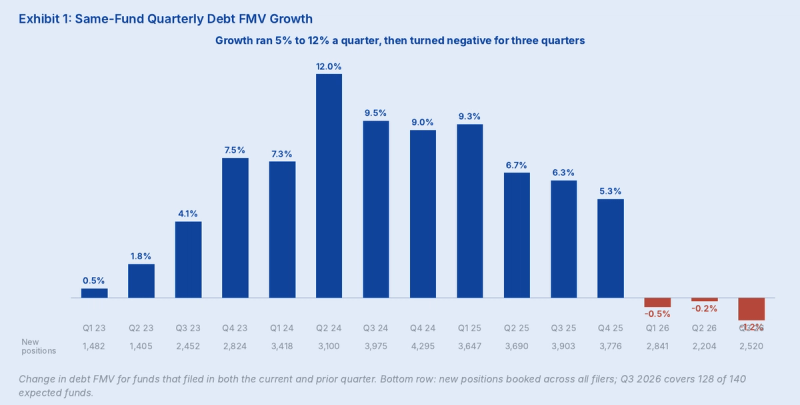
The book did not grow with it. Debt FMV at the 127 funds that filed both quarters fell 1.2% to $429.7 billion. That is the third straight decline and the largest of the three. Reporting is 91% complete, with twelve funds still to file, so every comparison here is same fund.
Deals came back even as the book shrank. The same funds booked 2,518 new positions, up 33% from Q2. Entries beat exits, 1,376 to 1,165.
The largest funds account for much of the shrinkage. HPS Corporate Lending fell 8.3% to $21.1 billion. Blackstone Private Credit Fund fell 3.1% to $71.1 billion. Of the eight largest funds, only Goldman Sachs Private Credit grew, and only by 0.2%.
Impairment eased for the first time this year. It stood at $10.3 billion, down about 6% on a same fund basis. Software impairment fell about 20%, and software was the only large sector to mark up.
The stress moved to other sectors. Eight of the ten largest added impairments sat outside software, and seven of the ten carry a non accrual disclosure. No single name added more than $71 million. Optimum, Material Holdings and Streamland Media all made the list with non accruals. Acrisure, an insurance brokerage roll up, fell from 90.8% to 81.1% of cost. Smaller losses across more sectors point to a broader credit cycle.
The software exception is insightsoftware. It is one of the most widely held names in the data, with at least 27 fund investors. In Q3, at least one lender disclosed non accrual. Its mark fell from 93.4% to 88.3% of cost. Its first maturity falls within 12 months.
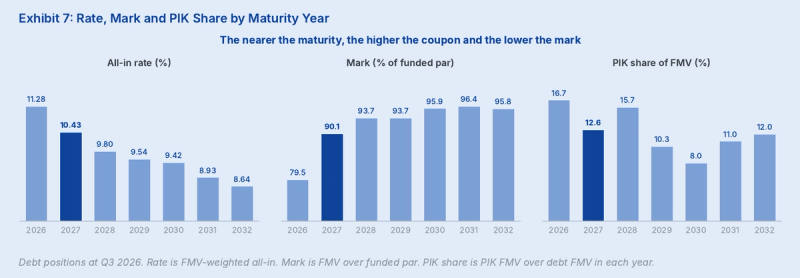
That brings the maturity wall into focus. $19.7 billion of funded par matures in 2027. It pays 10.43% and is marked at 90.1% of par. Loans due in 2031 pay 8.93% at 96.4%. The nearer the maturity, the higher the coupon and the lower the mark. If 2027 borrowers refinance at today's longer dated rates, lenders give up about 150 basis points on that paper. The weaker ones may struggle to refinance at all.
2028 is the larger test. $64.6 billion matures that year, more than three times the 2027 amount, and 15.7% of it carries PIK.
If you are an LP, watch the weakest 2027 names over the next two quarters. insightsoftware and Material Holdings both mature within 12 months, and both carry non accrual disclosures. Extensions, PIK amendments and paydowns will show how lenders plan to handle the wall before it arrives.
The full Q3 2026 Private Credit Quarterly, with all charts and data tables, is available as a downloadable PDF.